People sometimes ask me how do you keep up with news in this fast-paced world, since I seem to be "in the know" most of the time. All this new AI stuff happening every hour of every day, there's no way to read it all!
Yeah.
They're right. It's not possible to read it all. What I practice is just following my nose and reading whatever smells interesting to me. (Note: I read. I don't in general listen to many podcasts, because they're linear and hard to just skim and browse. I prefer to use my time to think, and I find that reading allows me to think. I just pause, lift my eyes, process the thoughts the text gave me, daydream a little, then continue simply by lowering my eyes back on the book. None of that pause-rewind -cycle that podcasts make you do.)
So, as you see, I just basically cheat and skim a lot. You see - if something is important, it will surface in so many places that it probably passes by my eyes at some point. And I trust my instincts on whether it's worth my time or not.
And – this is important – I don't need to know everything. I don't need to even read full articles. I don't need AI summaries. I just skim, read a sentence here and there and piece together an idea. And if that idea is interesting, then I read more. I wrote earlier about bead curtain shaped people. That's how you get one.
It's a version of "passive research" - that's when you turn on the TV and learn about whatever happens to be on. (In the old days you could learn about giraffes; these days you learn a lot about the social behaviour of young adults in zero clothing. It's interesting too, in its own way.) If I recall correctly, Esa Saarinen (a famous Finnish philospher) does a version of this method too where he just opens a book randomly and just reads a few paragraphs and then closes the book. Just enough to get an idea.
One thing I've found AI to be very useful at is hardening your web containers you've had online for 25 years. So this is a test to see if I can still edit after all the extra protection layers I've put into place...
Englannin kieleen on tipahtanut sana "meat proxy", jolla tarkoitetaan ihmistä, joka ei ajattele itsenäisesti, vaan kopioi tekoälyn vastauksen sellaisenaan keskusteluun. Näitä on viime aikoina alkanut näkyä aika paljon - osa myöntää suoraan kysyneensä chatgpt:ltä. Ehkä siksi, että he haluavat ulkoistaa myös vastuun – että älkää suuttuko minulle, suuttukaa tietokoneelle.
Haluan nyt ehdottaa tälle sanalle suomennosta "väliliha", vähän samaan tapaan kuin "kokousliha" tarkoittaa tyyppiä, jota kutsutaan kokouksiin koko ajan, mutta joka ei oikeastaan välttämättä kontribuoi niissä kovin paljoa.
Kuten joku sanoi hienosti: Ensimmäiset tyypit, jotka tekoäly korvaa työelämässä tyystin, ovat juuri näitä välilihoja. Heillä ei kun ole sellaisia ajatuksia, joita pomo ei saisi suoraan tekoälyltä itsekin.
TL;DR: Ei. Tai no. Osaa. Mutta ei erityisen hyvin, koska kyseessä ei ole strateginen peli.
Pidempi vastaus:
Kimble on Suomessa hyvin tunnettu Trouble/Frustration-pelin variantti, jota Tactic on julkaissut vuosikymmeniä kaikkien kesämökkien iloksi. Sen Pop-O-Matic -noppa on ilahduttanut lapsia, ja erilaisia lauta- ja sääntövariantteja on olemassa Angry Birds -Kimblestä opiskelijoiden suosimaan, lievästi epäilyttävään Norske Kimbleen.
Minulla — ja varmasti kaikilla, jotka ovat pop-o-maticcia koskaan hakanneet — on aina ollut lempistrategia. Ottaako aina kuutosella oma nakkula laudalle? Onko parempi edistää omaa nakkulaa vai syödä kaverin nakkula? Kannattaako siirtää taaimmaisinta vai etumaisinta nakkulaa?
Kun Anthropic antoi muutamaksi viikoksi pääsyn Claude Fable 5 -tekoälymalliin, ja kesälomakin sattui olemaan, niin päätin testailla tämän uuden tekoälymallin kykyjä ja rakentaa sekä pelimoottorin, jolla voi kokeilla erilaisia strategioita, että AlphaZero-tyylisen tekoälyn opetusjärjestelmän, joka oppisi pelin säännöistä lähtien. Hei, se toimi shakille ja go:lle, miksei sitten Kimblen kaltaiselle pelille?
Sellainen pieni huomautus, että tässä tarkoitan tekoälyllä nimenomaan hermoverkkoa, jota on koulutettu koneoppimismenetelmillä. En siis tarkoita sillä viiden rivin Python-algoritmia, jota ihminenkin voisi helposti soveltaa pelitilanteessa.
Ja toinenkin pieni huomautus, että tämä on mun ensimmäinen kosketukseni AlphaZero-tyyppisiin algoritmeihin. Olen kyllä tehnyt hermoverkoilla kaikenlaista muuta, mutta tämmöinen itse itseään opettava algoritmi oli ihan uutta. Joten on ihan mahdollista, että olen mokaillut jotain kovasti perusteellista. Oppia ikä kaikki.
Pelimoottori ja pelaajat
Pelimoottori on kirjoitettu Pythonilla, ja sitä voi käydä kärkkymässä Githubista. Koodi on pitkälti Clauden kirjoittamaa, joten ei siitä sen enempää. Ideana kuitenkin on se, että sille määritellään neljä eri pelaajaa, joista jokainen noudattaa omaa strategiaansa, ja sitten ne pelaavat esimerkiksi 10 000 peliä keskenään. Näin suuressa määrässä pelejä eri strategioiden suhteelliset erot alkavat näkyä.
Testasin muutamaa eri strategiaa, joiden suhteellisia eroja tarkastellaan sitten jutun lopussa.
- random — pelaaja, joka valitsee satunnaisen siirron laillisten siirtojen joukosta, mutta ei pohdi enempää.
- capture — pelaaja, joka pyrkii aggressiivisesti aina syömään muiden nakkuloita, mutta muuten valitsee siirtonsa satunnaisesti.
- runner — pyrkii siirtämään aina pisimmällä olevaa nakkulaansa.
- release — ottaa aina uuden nakkulan laudalle, jos vain voi.
- defensive — pyrkii valitsemaan syömisen, mutta muussa tapauksessa valitsee sen siirron, jolla pääsee pisimmälle (mielellään maalisuoralle).
- rescue — Defensiven muunnos, joka syö jos mahdollista, mutta seuraavaksi pyrkii aina pelastamaan oman nakkulan (siis jos toisen pelaajan nakkula voisi teoriassa syödä sinut omalla vuorollaan, jos toinen heittää hyvin).
- cautious — syö, jos mahdollista; mutta seuraavaksi valitse sellainen siirto, joka ei vie sinua sellaiseen paikkaan, jossa syödyksi tulemisen uhka olisi mahdollinen (eli ei toisen eteen).
- guarded — syö vastustajan nakkula, jos mahdollista; jos joku nakkuloistasi on uhattu, siirrä sitä; vältä siirtoja, jotka vievät sinut toisen eteen; siirrä ensimmäistä nakkulaasi.
- guarded2 — muuten sama kuin Guarded, mutta pyrkii pitämään vähintään kaksi nakkulaa kerrallaan laudalla.
- az-self — Tekoälypelaaja yksi.
- az-vs-guarded — Tekoälypelaaja kaksi.
Voit pysähtyä tähän kohtaan ja miettiä, noudatatko itse jotain näistä strategioista. Jos keksit hyvän, voit poimia lähdekoodin Githubista ja lisätä omasi sinne.
Sivuhuomio nopasta
Törmäsin mielenkiintoiseen sivuhuomioon: Kimblen Pop-O-Matic -noppa ei ole täysin satunnainen, kuten tässä artikkelissa on ansiokkaasti ja ranteita säästelemättä selvitetty. Nopan vastapuoli (eli 1-6, 2-5, 3-4) heitetään peräti 23,9 %:n todennäköisyydellä! Luonnollisesti Kimble-simulaattorini ottaa tämän huomioon ja ajattelin, että tekoäly ehkä oppisi hyödyntämään tietoa jotenkin. Osoittautui kuitenkin, että tällä ei ole hirveästi merkitystä.
Tekoälypelaaja
Kun algoritmiset pelaajat oli valittu ja testattu, seuraavaksi koulutin tekoälypelaajan. Tässä käytettiin AlphaZero-taktiikkaa, eli oleellisesti annettiin tekoälyn vain pelata itseään vastaan niin kauan, että se oppi pelaamaan peliä hyvin.
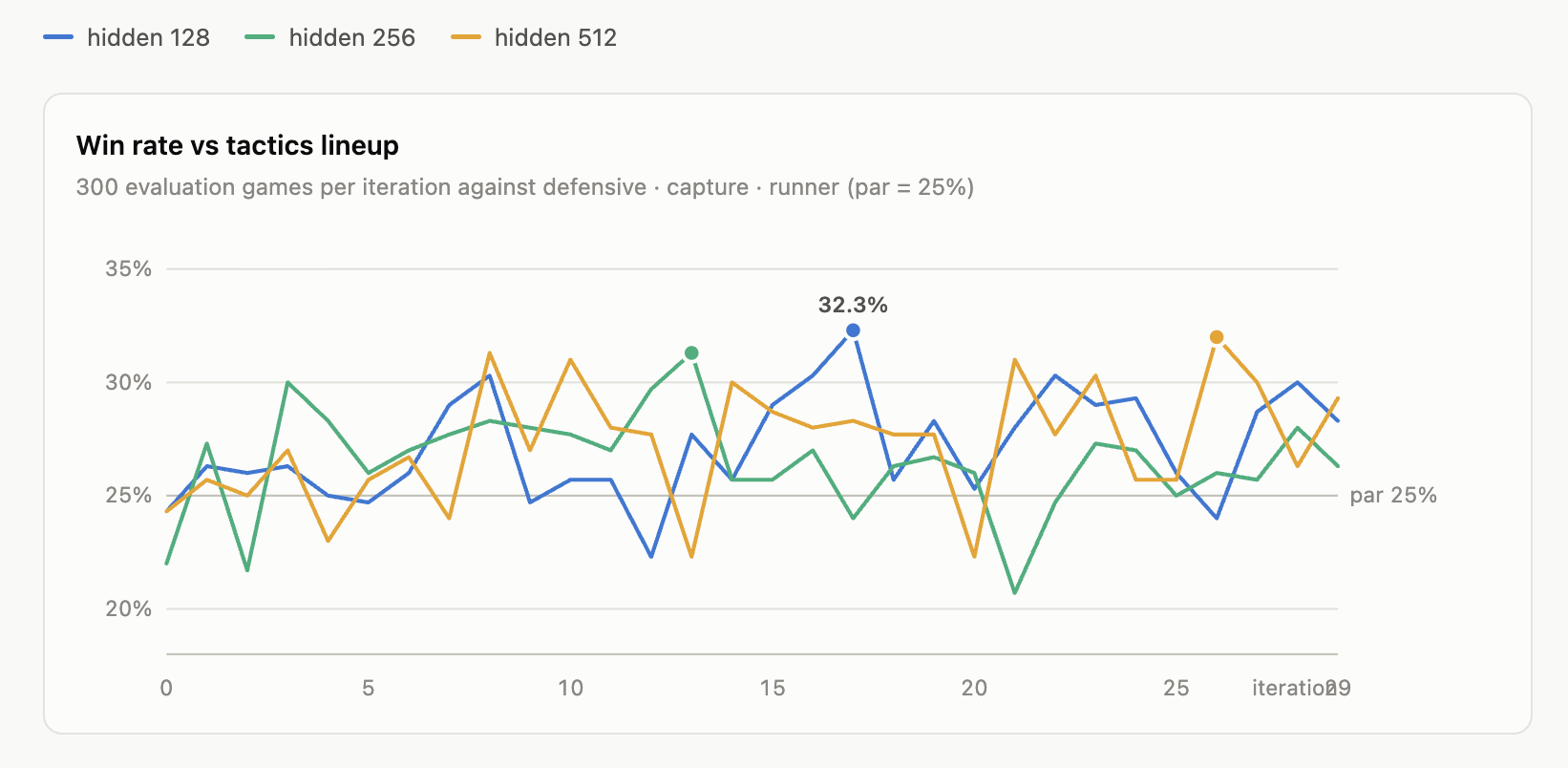
Kimble on pelinä kuitenkin paljon yksinkertaisempi kuin shakki tai go, joten koulutettava hermoverkkokin oli paljon yksinkertaisempi. Yksinkertaisimmassa versiossa oli noin 85 000 parametria (128 piilotettua neuronia) ja monimutkaisimmassa noin 530 000 parametria (512 piilotettua neuronia). Simulointeja tehtiin 200 tai 800 per siirto, mutta 200 riitti mainiosti. Erot voittoprosenteissa eri kokoisten piilokerrosten välillä eivät kuitenkaan olleet tilastollisesti merkitseviä. Training loss parantui tasaisesti 1.05 → 0.99 → 0.96 mentäessä leveämpiin verkkoihin. Isommat verkot siis oppivat datan paremmin, mutta eivät muuttuneet yhtään vahvemmiksi pelaajiksi.
Koulutin verkot omalla Apple Macbook Air M4 -koneella, mihin meni koosta riippuen muutamasta minuutista muutamaan kymmeneen minuuttiin. Koulutin kaksi pelaajaa: az-self, joka opetteli pelaamaan itseään vastaan, ja az-vs-guarded, jolla oli pelikumppanina vain guarded-pelaaja.
 |
Turnaukset
Tietokonepelaajien keskinäinen paremmuusjärjestys ratkaistiin sitten pelaamalla perinteisiä round-robin -turnauksia, käyttäen Plackett-Luce -pisteytystä. P-L on eräänlainen ELO-pisteiden yleistys useammalle kuin kahdelle pelaajalle. Kaksinpeleissä kun on aina vain voittaja ja häviäjä (tasapelit, juujuu, mutta ne eivät vaikuta pelaajan suhteelliseen vahvuuteen), mutta nelinpeleissä pitää ottaa huomioon se, että toinen sija on parempi kuin kolmas tai neljäs.
Pelit pelattiin siihen asti, että yksi pelaaja voitti. Muut sijat jaettiin niin, että eniten kotiin nakkuloita saanut sai kakkossijan, jne. Toissijaisesti katsottiin sitä, kenellä olivat nakkulat kaikkein pisimmällä.
Kimble-pelejä pelattiin yli sata tuhatta. Mielenkiintoinen tieto muuten oli se, että neljän hengen Kimble-pelin pituus on keskimäärin 250 vuoroa. Kahden hengen peli kestää keskimäärin 107 vuoroa ja kolmen hengen 174 vuoroa.
Kimble ei kuitenkaan oikeasti ole kovin strateginen peli. Kuten allaolevasta taulukosta näkee, noin 80 %:ssa kaikista vuoroista on vain yksi ainoa vaihtoehto: joko istua käsillään tai sitten siirtää sitä ainoaa nakkulaa, jota ylipäätään saa siirtää. Neljän hengen pelissä, joka kestää 250 vuoroa, se tarkoittaa sitä, että jokaisella pelaajalla on vain noin 12 strategista päätöstä tehtävänä pelin aikana. Jokainen pelaaja saa kuitenkin heittää noppaa keskimäärin 63 kertaa, ja kuten tiedämme, sehän Kimblessä oikeasti on tärkeintä.
| Laillisten siirtojen määrä | Osuus vuoroista |
|---|---|
| 0 (ei voi siirtää mitään) | 31,6 % |
| 1 (pakotettu) | 49,1 % |
| 2 | 18,1 % |
| 3 | 1,2 % |
| 4 | 0,04 % |
Tämä tarkoittaa sitä, että jos yhteen vuoroon nopan heittoineen, miettimiseen, nälvimiseen, voivotteluun ja itse siirtoon menee kymmenen sekuntia (eli sellainen rauhallinen tahti), ja jokaiseen vuoron skippaamiseen menee kaksi, niin peli kestää keskimäärin 1880 sekuntia, eli noin 31 minuuttia. Kolmen hengen peliin menisi vastaavasti 22 min ja kahden hengen peliin 13 min. Jos pelaajia on vähemmän, myös nakkuloiden syömisiä tapahtuu vähemmän, joten pelit ovat vastaavasti hieman nopeampia.
Turnaustulos
Tässäpä sitten se varsinainen pihvi, ja tunnustus omasta riittämättömyydestä: en saanut tekoälyä pelaamaan paremmin kuin hyvin yksinkertainen, käyntikortin takapuolelle mahtuva algoritmi. Teoriani on se, että Kimblessä satunnaisuus on kuitenkin sen verran iso elementti, että AlphaZeron tyyppinen perushermoverkko ei vain osaa mallintaa sitä. Paras hypoteesini on se, että verkon arvopää (value head) käytännössä yrittää mallintaa kohinaa tilanteessa, jossa käytännössä melkein koko ajan laillisia siirtoja on vain nolla tai yksi. Toivon, että joku, joka oikeasti ymmärtää tämän matematiikan päälle enemmän kuin minä, haluaisi uppoutua asiaan tarkemmin.
Kuten kuvasta näkyy, guarded2 pesi kaikki muut algoritmit mennen tullen turnauksessa, jossa pelattiin yhteensä 102 960 eri peliä. Hermoverkkopohjaiset tekoälyalgoritmit tulivat vasta sijoille 4 ja 5. Oikeassa laidassa ovat lasketut P-L vertailuluvut.
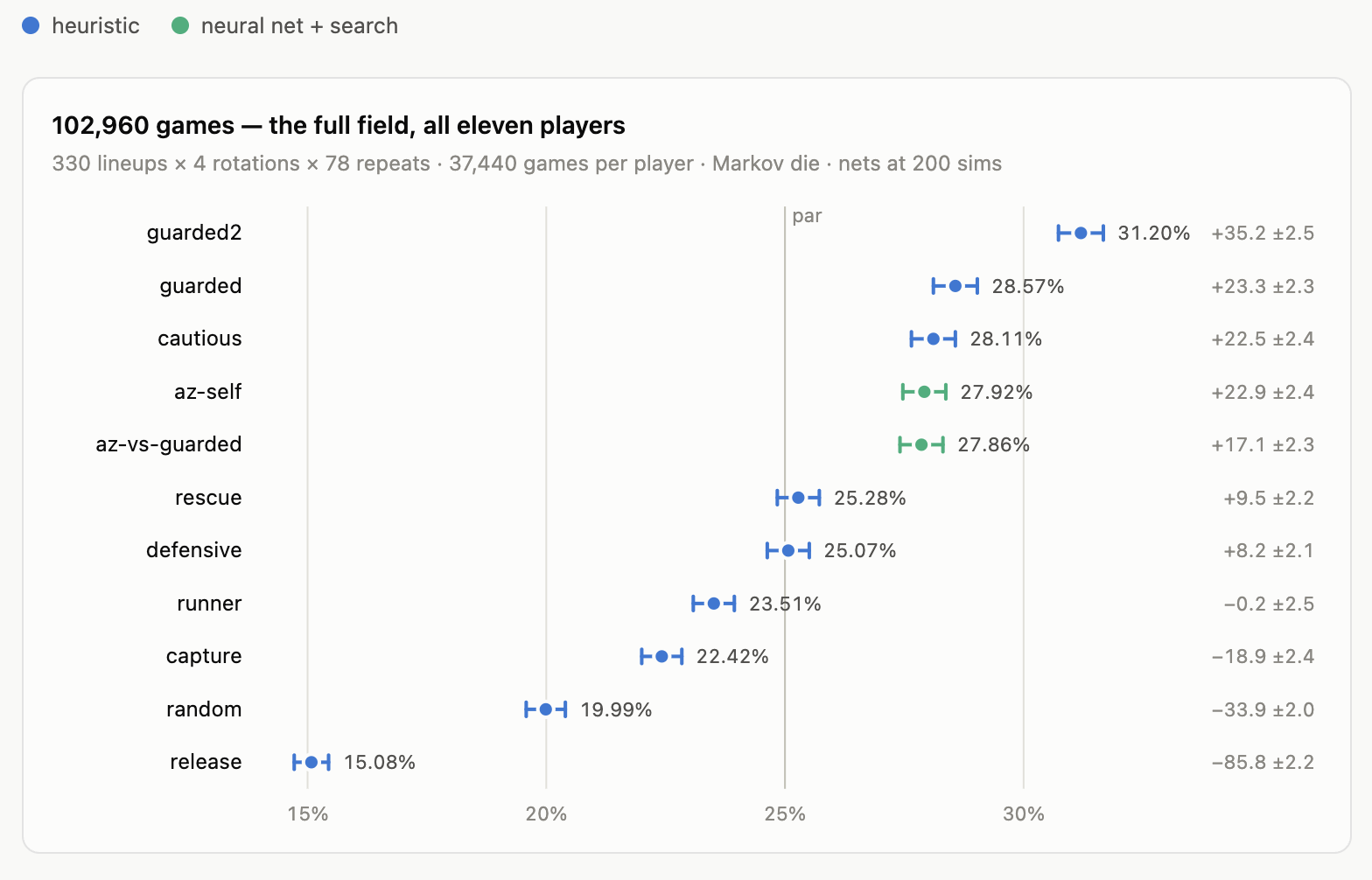 |
Miksi sitten tuo guarded2 pärjäsi niin hyvin? Se on mielestäni melko tasapainoinen: ensinnäkin toisen pelaajan nakkulan syöminen on aina hyvä asia, koska se saattaa estää toista pelaamasta pitkäänkin. Todennäköisyys heittää kuutonen on kuitenkin pitkällä tähtäimellä vain 1/6.
Toisekseenkin se välttää joutumasta tilanteisiin, joissa voit itse joutua syödyksi.
Kolmanneksi, mitä useampi nakkula sinulla on laudalla, sitä todennäköisempää on, että joku niistä joutuu syödyksi, mutta toisaalta, jos sinulla on vain yksi, niin joudut herkästi tilanteeseen, jossa et voi siirtää mitään.
Mielenkiintoisesti sellainen strategia, jossa aina otetaan nakkula laudalle (release), oli selkeästi huonompi kuin muut, ilmeisesti juuri siksi, että se tarjosi niin paljon syötävää muille.
Lopuksi
Paras löytämäni pelitaktiikka (guarded2) on melko yksinkertainen. Se voittaa noin 31 % neljän hengen peleistä ja on parempi kuin tekoälyalgoritmit. Valitettavasti 31 % ei kuitenkaan ole mikään varma voitto; pelejä tarvitaan satoja (eli kesäsään pitää olla todella, todella huono), että tällä taktiikalla pärjää oikeasti.
Ei siis kannata uhrata tähän enempää aikaa; olkaa vain tyytyväisiä, että minä tuhlasin. Ihan kaikki tavat pelata Kimbleä ovat hyviä — joskin Norske Kimblen kanssa olen hieman epäileväinen.
Joten tässä Jannen Algoritmi, olkaa hyvä:
- SYÖ: Syö aina toisen nakkula, jos voit. Jos sinulla on useampi mahdollisuus, syö kaikkein pisimmällä oleva.
- SUOJAA: Älä siirry toisen eteen niin, että hän voi seuraavalla vuorolla syödä sinut.
- LASKE KAHTEEN: Tuo uusi nakkula laudalle kuutosella, jos sinulla on alle kaksi omaa nakkulaa laudalla JA lähtöruutusi ei ole vaarassa.
- JUOKSE: Siirrä aina pisimmällä olevaa nakkulaa.
(Internet-huomautus: koskapa joku kuitenkin voi pahoin sanasta nakkula ja haluaa ehdoin tahdoin kertoa, että oikeasti se on nappula tai tikku tai joonas tai naapurin skodan ilmanraikastin, niin olkaapa kerrankin kivoja ja jättäkää tämmöiset asiat kertomatta, jooko? Mun blogi, mun sanat.)
(Toinen internet-huomautus: ottakaa tuo Github-repo ja tehkää siitä parempi. Tämä on vain muutaman päivän aivopieruilun tulosta yhdistettynä melko edistyneen tekoälyn tulosteisiin, ja joku joka Oikeasti Tietää Asioista osaa varmaan Tehdä Asiat Paremmin. Ja keksikää lisää algoritmeja ja pelauttakaa niistä vastakkain! Joku varmaan keksii paremman kuin minä…)
If your blog reader is not showing the headlines correctly (so this should be "RDF users note", not "Main_blogentry_020826_2"), make sure you are pointing at the "rss.jsp" page or "atom.jsp" instead of "rss.rdf", which I have not patched to support proper weblog format.
Yeah, I've been meaning to do this fix for... you know, 20 years or so, but never got to around actually doing it. But now with Claude as my helpful assistant, I got it done! AI has actually been quite helpful to tighten up configs and clean up stuff. I was able to add even a new spoiler feature !
If you have no idea what I just said, but are still seeing weird headlines, just unsubscribe and resubscribe and things should work.
OK so I have been on vacation for three weeks now (yes, it's the dreaded European vacation, which is one of the things keeping us happier than most – no, all – other countries)! Personally I find it very useful in giving my brain the freedom to tackle non-essential things.
Like updating this blog.
It's basically been neglected for a few months now (and the actual layout and stuff has been neglected for 20 years!) So I embarked on some light cleanup: I removed a ton of obsolete web metadata stuff and embraced new standards; the RSS feed now has actual proper titles and images for blog posts; the Feedblitz stuff was fixed; the canonical URL for this site is now "ecyrd.com" instead of "www.ecyrd.com"; and most importantly, I created a whole new landing page.
For 23 years, I just forwarded everyone landing on ecyrd.com directly to this blog. No more! There's now a proper landing page with links, my picture, etc. It's like I'm joining the self-promoting hustle culture, just 25 years late to the party!
Seriously though... With the enshittification of all the platforms, and the fact that if you build your online brand on someone else's platform, you can quickly lose it, makes me want to embrace the blogging culture and self-run websites again. Not that I have much of a brand, but I have a feeling stuff like this is going to be more commonplace. If you own your own domain, you should build your identity there, not on Meta platforms, probably. They're fine, but be ready for the moment you need to abandon them.
Of course running your own site is a lot more trouble. But at some point you have to ask, how much trouble your online presence is worth?
The idea of AI as a creator goes deep into how you actually view your media consumption: Do you only take it as-is? Without context? Do you care about who made the music or the book? If you believe in the death of the author, as was argued back in the day, then yes, it is entirely possible AI will create a song or a book or a movie that you will like. It is in fact, likely, because AI can already create songs which are good enough to hit the charts. They may not be original, but honestly, not a lot of the modern pop is original.
Many people have argued this to me: I don't care who made the song/book/whatever, so AI can do just as well as a human. And I understand where they're coming from, sure. If you view yourself just as a passive consumer of content, AI will be perfect for you. It will produce personalized content for you to consume all day.
But humans like stories. We view movies from "that one director we like". Or read books from "that lady who writes so well". Or go apeshit about some band. If the trail ends up at "Oh, it's AI", there is no depth in the story. It's about as shallow as an ad. Heck, even Instagram influencers have more depth, no matter how inane they are. At least they're humans you can root for.
But AI? No. It's content designed to use your limited time so that you do not use your time with things created by people, because people are expensive and needy, and they stand in the way of corporate profits. (Note that I think there are wonderful ways to use AI to enhance your own creativity or productivity. I feel even giddy about some of the ways I've used AI recently. But the massive majority of AI-generated content will not be done by individual creators, but the corporate content machines.)
While researching for something else I came across this presentation from a few years ago. Of course, it's a bit ironic to talk about this in a service that involves interruptions and scrolling, but… who cares. I don't.
I would like to link this idea to the fact that there is a lot of talk about how AI will create all content in the future. Mark Zuckerberg even fantasizes about how artificial intelligence will be everyone's friend in the future, and the content offered to you will be completely personalized.
However, people don't actually want ''content''. They want experiences, and content is what you get when you think about the most scalable version of the worst possible experience that maximises the engagement. By "scalable" I mean the potential for the highest turnover, and by "worst" I mean what can be produced at the lowest cost.
When AI starts to create content it does it because companies want to have more scalable content production. Computers are far more scalable than humans, so this is not a big leap in imagination. And it doesn't matter whether it's personalized for you or not, it's still content, that is, the most efficiently produced that will keep you engaged the most. (Center for Humane Technology has a lot to say on this.)
The thing is, it will create an ever-increasing gap between content and experience. Different social media companies and news organizations already have to resort to dark design patterns to keep people engaged in this shitty content of theirs, and in the future, when the number of people you can hire is no longer the limiting factor on the amount of content you can produce, you will need to produce even more to be visible in this grand storm of mediocre content that will sweep the internet.
I think the human capacity for content is limited, simply because we run out of time. We only have limited waking hours, and most of those hours are not available for content: we work, we travel, we exercise, we eat. Yes, you can feel content slipping its tentacles to your travel time, or exercise time or eating time – even toilet time. But it is because of these dark patterns of addiction that the social media companies have learned to abuse. We can scroll for hours, but feel terrible afterward. At some point we learn.
But we're hitting a kind of a limit though. One thing that AI does well is that it provides you with interactivity. You can actually engage with a metal mind on topics that puzzle you. Yes, it's sycophantic, it hallucinates and it will make mistakes. It can even be politically influenced, and it can incorporate many dark patterns too. But all that time spent on talking to ChatGPT or Claude or whatever is away from passive consumption of tokens generated by massive bot farms.
And I think this is a good thing. There is conflicting evidence on whether is a difference between passive and active consumption of the internet, and $deity only knows that we can spend way too much time on trivial things. But! One thing that has always taken humanity forward has been standing on the shoulders of the giants, and building a common base. Wikipedia has been a shining example on how humans can build together something remarkable with just tiny contributions. AI is a supercharged version of that. I believe it is possible to use AI to create better versions of ourselves: more educated, more curious, more human. It's just that we have to actively fight the slop that is filling our screens and ears.
One of the reasons why I have given up on Twitter and Facebook is the amount of algorithmic content that always tries to sell me stuff, or make me more engaged with the content. I much prefer the feeling on Threads and Mastodon, not because of the lack of algorithms, but because they both feel more human. I can actually connect and talk to humans. I can go out with people I met online and have a meaningful experience with them. The Threads algorithm isn't actively trying to make me angry and Mastodon's algorithm is so dumb it hardly deserves to be called an algorithm. My experience with both is vastly superior to anything else.
So call this a gut feeling, but… I feel like we don't have to really worry about AI-generated content taking more of our time. The gap between AI-generated content (aka "AI slop") and real experience feels like it's widening.
So yeah, sure, use AI to reduce clutter in your life or do research or even talk to an infinitely patient AI friend. All of that stuff is away from content consumption. You don't have to be a passive consumer. You can use modern tools to shape your own life.
In 1957, one of the greats of science fiction, Isaac Asimov, wrote one of his famous robot books: The Naked Sun. He describes a world called Solaria, where only 20,000 humans live alone on vast estates, with every need catered to by a billion robots. They, of course, have a vibrant social life, but only by “viewing,” that is, telepresence. “Seeing” other people physically is frowned upon so much that people feel nauseated if another living person is in the same room. (Then a murder occurs, and a detective is sent to investigate from planet Earth – a planet with billions of inhabitants, where privacy is rare and underground city streets are constantly crowded with millions. The Solarians are naturally distraught, and this drives a lot of tension in the book. It’s a great book; you should read it!)
Why dig old speculative fiction? First, I like it. Second, sci-fi writers make their living by thinking very hard about the future, but without a lot of pressure to be “sensible” in whatever way “sensible” is defined in their times.
And third: You can be very sure that the current tech leaders have read the same books. Some of them are actively trying to bring some of them to life.
What got me thinking about this book was some of the weak (and not so weak) signals that I’ve been seeing recently.
We are losing the human connection
Even before the COVID-19 pandemic, remote work was on the rise. The freedom to work any time from anywhere was holding great promise to certain expert jobs, but COVID-19 really broke the bank, and many people found out the hard way that yes, their jobs could also be done remotely.
And I get why people like remote work: commuting is terrible and skipping it frees hours of your time per day. Working remotely means you can also find more affordable housing away from the city. There are clear productivity gains for certain tasks when you are basically in focus mode most of the time and don’t have to suffer constant interruptions. For the more introverted people, remote work can be a great anxiety management system.
Also, while we are right now seeing AI replacing white-collar entry-level jobs, we’re also seeing the first steps of human-like robots stepping into the areas traditionally thought of as blue-collar jobs such as factory-floor work. It is obviously a huge disruption when a programmable, mass-producible tool can be used to replace workers in entire industries. It has happened before, and we remember those times as the First and Second Industrial Revolutions.
At the extreme, we see the *otaku*, people who like to isolate in their own homes and not have any physical social interactions. Everything is ordered online, including social life.
A not-so-extreme example is how people in Western countries are turning inwards, something that the Harvard Kennedy School calls the “Friendship Recession”. People spend more time at home and less time seeing friends. The so-called Male Loneliness Epidemic (which is more likely an “everybody loneliness epidemic”) is just one aspect of this.
Return of the teenage bedroom
This is honestly a bit of a weak pet theory of mine, so you are free to ignore this chapter, but hear me out: A massive portion of the internet innovation happens because the young founders, barely out of college or university, desire to go back to the happiest period of their lives — the teenage bedroom. Dad drove you around? Uber. Mum made you food? DoorDash. Endless entertainment? Netflix. Hanging with friends around the mall? TikTok. Dreams of the conquest of space? SpaceX.
Many of the corporate founders are people who had only very limited experience of life when they started. They locked in a particular kind of culture, and the stereotypical CEO self-searching and experience hunting cannot really change the culture already established.
I like this hypothesis as it sort of kind of explains in my mind why we don’t seem to evolve as a society that much. Yes, tech evolves, but the big and massive societal changes seem to revolve around the comfort of the middle-class teenage bedroom from the 1990s.
The rise of the social algorithm
There is also a big social experiment running — the regular human contact is being mediated, perhaps even replaced, by social algorithms. You no longer just meet people because you happen to share the same job, hobby or local pub; no, you see content from people that the algorithm deems suitable for you. An algorithm that’s optimized to maximize your engagement with the site itself, not with the people. Sometimes it’s as simple as listing the latest content – the Fediverse is the linear-TV equivalent of social media – but the smartest algorithms are self-learning and very good at wasting your time. Time, of which you have a limited supply.
But the big thing is *scale*. Internet companies are built around scale: they need to grow their revenue constantly. Some economists argue that in service industries, there is no limit to growth, but most firms battle for eyeballs and user time, both of which are limited resources.
Frictionless wins
One key thing in the online battle is the idea that frictionless wins. The company that builds a service that needs less interaction, less learning, less commitment and less money from the user is more likely to win the fight.
The problem is that online is almost always less friction than physical. It’s easier to order stuff online than walk to the store. The assortment is always better. The prices often cheaper too, if you don’t mind waiting an extra day. In Finland, robots deliver your groceries so you don’t have even the social friction of meeting a human.
The need for growth automatically drives internet companies to less friction by reducing the physical activities of customers and moving towards online. Meeting people is a hassle. Calling them is less of a hassle. Messaging them is even less of a hassle. Watching a TikTok stream is even less, since you don’t really have to do anything; not even swipe.
Frictionless scales.
Growth needs scale.
Therefore, the internet companies (well, any company really, but the internet companies are at the forefront) are compelled to drive *solarification* of the world. We simply need to be isolated and pampered by robots, because it’s the only way towards a truly frictionless world.
Roll “save vs limitless growth”
Of course, this is hyperbole. My desire is just to highlight that there is a logical end result for the growth needs of the internet companies, and call for more human technology.
Still, there is delicious irony in looking at internet CEOs railing against remote work, yet trying to make sure their users never have to meet a living human. Return-to-office does not make work have less friction, on the contrary! Work life is stressful, and with our population aging with less people supporting the economy, it’s likely to become even more so.
There is also growing awareness of the mental and physical toll that isolation and stress takes on you. People who work from home might move less (there seems to be conflicting research on this), and anxiety appears to be increasing on the whole.
Also, bluntly put, there are limits to growth. The “Limits to Growth” model from the Club of Rome, and its updated versions, does set some hard limits on how much growth can be achieved. But if you think about it this way: 20,000 people would not be a big burden on Earth, no matter how advanced a lifestyle they lead. So perhaps there is a callous movement out there as well, people who plan to be the progenitors of those 20,000.
So what?
A very good question indeed, my friend! I’m sure some of my readers are right now thinking that hey, that does not sound so bad, actually. Living in a utopia, where you don’t have to meet dumb people, and all your needs, wishes and fantasies are catered to by intelligent robots.
For others, this would be an absolute dystopia. Not being able to meet and feel other people? Spending your entire life in a high-tech version of Teams? Horror.
And, for engineers, you have to think about the brittleness of such a system: Is there enough genetic variance? Could power be grabbed and society be disrupted by bad actors? How about global tech malfunctions or natural catastrophes? Could society survive with such low numbers of people? What would happen to culture? Would they entertain themselves with an infinite number of old TV reruns and an unlimited stream of jabbering in Teams meetings? Would it be a monoculture, and we would lose all historical context of the thousands of cultures enriching humanity right now?
Could such a society *evolve* in any direction, or would it be a stagnant endpoint?
Private comments? Drop me an email. Or complain in a nearby pub - that'll help.
|
|
| "Main" last changed on 10-Aug-2015 21:44:03 EEST by JanneJalkanen. |


